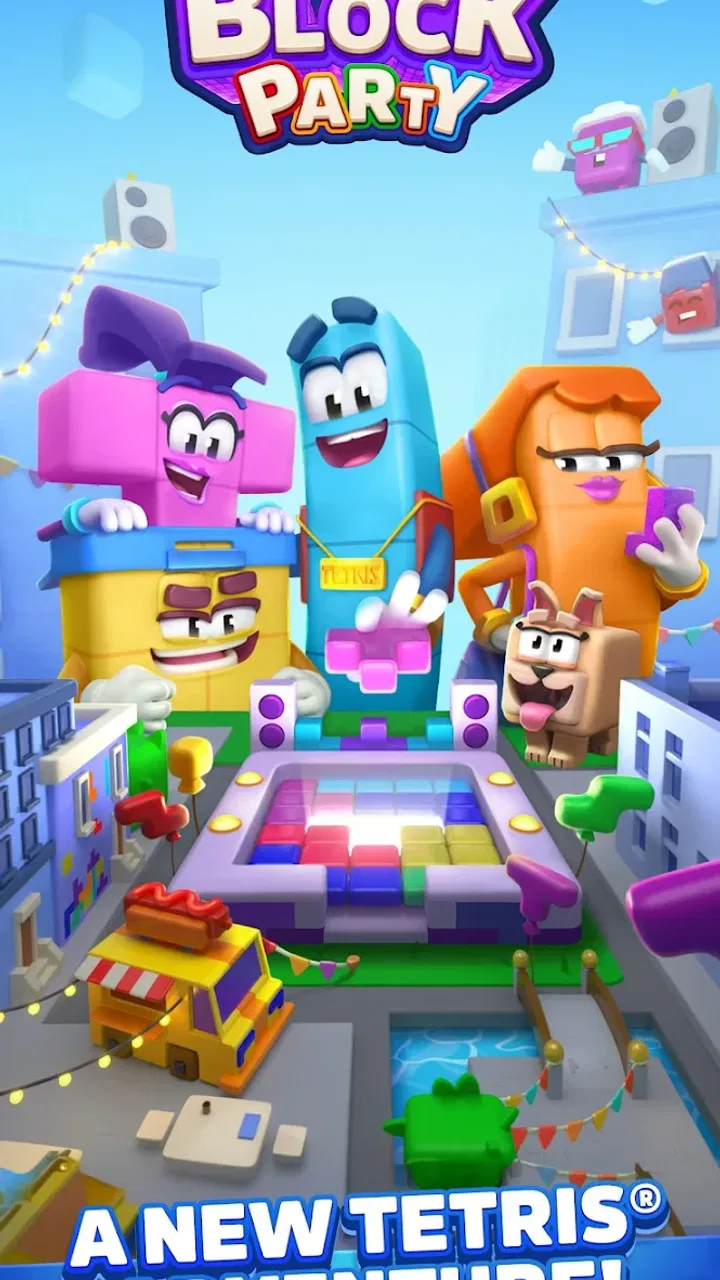
Tetris® Block Party
- 4.8
- Rating
- 1.00M
- Installs
- Free
- Price
 Analysis by App-foxy
I spent time with Tetris® Block Party as a casual puzzle game, and my first impression was familiar but not old-fashioned. The falling-block idea is instantly understandable, yet the “build and attack” angle gives each session a more competitive mood than a quiet solo puzzle. It feels aimed at people who already enjoy Tetris-style play but want a more social reason to keep returning.
The game is developed by PLAYSTUDIOS US, LLC and is available as a free download for Android users. It is listed for Everyone, which makes the basic concept easy to share across a household, although the competitive parts may still suit older players who enjoy pressure and quick decisions more than very young children. The current version is 1.2.2, and it supports Android 7.0 or later.
What makes this release worth discussing is not simply the familiar name. The important question is whether this particular take on block puzzles gives me enough to do beyond arranging pieces. After playing it, I would describe it as a good choice for short, repeatable sessions, especially when I want something more active than a traditional offline puzzle. I would be more cautious if I wanted a completely quiet, distraction-free version of Tetris with no competitive emphasis.
You May Also Like

 Blood Strike: 2.5 Anniversary
Blood Strike’s Loadouts Turn Every Drop Into a Tactical Gamble
A close look at Blood Strike’s custom loadouts: how fast access to signature weapons reshapes its battle royale rhythm, rewards preparation, and narrows the gap between fights.

 Pandora - Music & Podcasts
Pandora’s Music Is Easy to Start, but Harder to Recover
Pandora’s strength is its low-effort path from a seed to a station. Its weak spot is how much confidence it asks you to place in connection, setup, and quiet recovery.

 8 Ball Pool
 Is Built on Rivalries, Rematches, and Routine
A close look at the rivalries, rematches, shared routines, and unanswered safety questions that turn a quick pool match into a persistent mobile community.

 Samsung Music
’s Quiet Strength Is Playing What You Already Own
Its reach comes less from spectacle than from dependable access to a personal library. That simplicity is both the app’s strongest retention engine and its ceiling.

 AccuWeather: Weather Radar
AccuWeather Review: A Quick, Clear Forecast for Everyday Decisions
For everyday plans, the best forecast is the one you can understand quickly. AccuWeather makes rain timing, radar, and local conditions easy to act on, with a few trade-offs.

 Hill Climb Racing
Why Hill Climb Racing Still Turns Crashes Into One More Run
A tiny car, a bumpy hill and one more upgrade: Hill Climb Racing keeps resurfacing because its simple chaos makes every near-miss feel personal.
More From Our News Desk



How the free model affects the experience
The starting point is straightforward: the game costs nothing to download. That matters because it lets me try the core experience without committing money first. For someone deciding between several puzzle games, free access lowers the risk considerably. I can see whether the controls, pace, and social direction suit me before considering any optional spending.
There are in-app purchases ranging from $0.99 to $299.99 per item. That is a very wide range, so I would approach the purchase side carefully rather than assuming that every player needs to spend. The free entry is the clearest value here; the paid side should be treated as optional until I understand exactly what a particular purchase changes for my own play.
In practical terms, I would not install it expecting a single paid package with every part of the game permanently settled. I would install it to test the free experience, then decide whether continued play justifies any optional purchase. That distinction is important: the game can be worth trying at no cost, while the value of spending depends on how often I play and what the available items do for my sessions.
I also recommend setting a personal spending limit before getting deeply involved. The upper end of the listed purchase range is substantial compared with the free download, so impulse buying could quickly change the value calculation. For me, the sensible approach is to enjoy the free portion first, identify whether I am actually returning regularly, and only then consider a small purchase if it solves a specific frustration.
The familiar puzzle loop still does the heavy lifting
The strongest part of the experience is the basic block-placement rhythm. Pieces arrive, I look for a useful landing position, and I try to keep the board from becoming unmanageable. That loop works because every move is both immediate and consequential. A careless placement can create problems several turns later, while a tidy arrangement gives me room to recover.
That makes the game easy to pick up but not automatically easy to master. A new player can understand the objective almost immediately, while a practiced player can focus on efficient stacking, planning ahead, and recognizing when a risky move is worth taking. I like that difference because it gives short sessions some depth without requiring a long tutorial or a complicated rulebook.
The more interesting change is the social framing. The idea of building and attacking friends shifts my attention away from simply surviving on my own. I am not only asking whether a piece fits; I am also thinking about how my progress affects another player. That creates a more urgent kind of puzzle decision, particularly for people who enjoy friendly competition rather than chasing a personal score in isolation.
One useful habit is to treat the lower part of the board as a resource rather than filling gaps as soon as I see them. Keeping a clean area gives me more flexibility when the next pieces are awkward. In a competitive setting, that patience can matter more than making a flashy move immediately. I found that the best decisions were often the unexciting ones: preserving options, avoiding a tall uneven stack, and waiting for a better opportunity.
Why the attack angle changes how I play
Traditional Tetris-style games often reward concentration on my own board. Here, the attack concept gives mistakes a larger emotional effect because the result is connected to another person. A strong run feels more satisfying, but a poor sequence can also feel more frustrating when I know the opponent may benefit from it.
That makes the game a better fit for a quick challenge with a friend than for someone who wants a calm mental exercise. If I am commuting, waiting for an appointment, or taking a short break, the competitive structure gives the session a clear purpose. I can start with the intention of playing briefly, make decisions immediately, and stop after the match rather than drifting through an endless solo score chase.
There is also a small strategic trade-off in playing aggressively. Trying to create pressure can tempt me into arrangements that damage my own board. The safer approach is to maintain a stable foundation first and attack when the position supports it. That is one of the less obvious lessons I took from the game: the attack theme does not mean every move should be aggressive. Good defense remains part of effective offense.
For players introducing the game to friends, I would suggest agreeing on a relaxed attitude before starting. A puzzle match can become surprisingly intense when both sides understand the rules and want to win. That is enjoyable for competitive groups, but less suitable for someone who becomes annoyed by fast reversals or repeated losses. The social feature adds energy, not necessarily comfort.
Everyday situations where it fits well
My favorite use case is a short break when I want something more engaging than scrolling but do not have enough time for a long game. A few rounds can give me a defined activity with a clear beginning and end. The familiar controls also mean I do not need to spend the whole break learning a new system.
It can work well as a shared challenge between friends who already enjoy puzzle games. Instead of sending a message that says “try this,” I can frame it as a quick contest and compare how each of us handles pressure. That social purpose is more convincing to me than using it as a replacement for every other mobile game.
It is less convincing as a relaxation tool. The attack-oriented setup encourages attention and reaction, so I would choose a quieter solo puzzle if my goal were to unwind before sleep or play without feeling observed. The same feature that gives this game personality can make it feel busier than a classic standalone Tetris experience.
What value it delivers beyond a simple clone
The value is mainly in the combination of a recognizable puzzle foundation and a competitive reason to replay. I do not need to learn an elaborate fictional world, manage a large collection, or follow a long narrative before enjoying the central activity. The game gets to the part I came for: placing blocks and trying to outplay someone.
That simplicity is useful for mixed-skill groups. A friend who knows the basics can start quickly, while a more experienced player can still find room to improve through better planning. The gap between “I understand this” and “I can consistently win” is where much of the replay value lives.
The listed audience rating of Everyone also supports its role as a broadly accessible puzzle game. I would still use judgment when handing it to a child, especially because competitive play and optional purchases can change the experience. The age label tells me the content is broadly suitable, but it does not remove the need for sensible supervision around spending or online interaction.
The strong reception is another reason I would give it a fair trial: it carries a 4.7 average from around 42 thousand ratings, and it has passed over a million installs. Those figures do not guarantee that I will enjoy the pace or purchase model, but they do suggest that the concept has reached a substantial audience. I see them as a reason to investigate, not as a substitute for personal fit.
Small techniques that improve the first sessions
My first recommendation is to prioritize a flat, flexible stack over immediate line clearing. Clearing a line feels productive, but preserving space can be more valuable when the next pieces are inconvenient. I try to avoid creating isolated holes beneath a high surface because they reduce the number of useful placements later.
Second, I would resist treating the attack mechanic as a button I must use whenever it is available. The better moment is usually after I have stabilized my own board. This reduces the chance that an attempt to pressure the opponent leaves me unable to respond to the next sequence.
Third, I would use early matches to learn the rhythm rather than judging my skill too quickly. A competitive puzzle can feel unfair during the first few rounds simply because I am still dividing attention between my board and the opponent. Once I make board maintenance automatic, I can spend more thought on timing and pressure.
Finally, I would stop playing a particular session when I notice that I am making rushed placements just to recover from a previous mistake. The game is designed around quick decisions, but forcing another round while frustrated usually makes the experience worse. A short break protects the fun and helps me return with a clearer plan.
Where the trade-offs become noticeable
The biggest limitation is that the social and attack-focused identity will not appeal to everyone. Players who want the pure, meditative version of falling-block puzzles may prefer a conventional solo alternative. A standard Tetris-style game can be better when I want to focus on personal improvement without another layer of competition.
The free-to-play structure also deserves attention. Free access is genuinely useful for trying the game, but the presence of purchases from $0.99 to $299.99 means I would not treat the entire experience as cost-free in every practical sense. The right question is not simply “Is it free?” but “Can I enjoy it comfortably without buying anything, and do I understand the benefit before spending?”
Another trade-off is emotional intensity. Attacking a friend can make an ordinary puzzle feel exciting, yet it can also turn a casual break into a frustrating loss streak. If I want a game that stays gentle regardless of the result, this may not be my first choice. If I enjoy rematches and learning from mistakes, the same tension becomes a strength.
I would also avoid assuming that the familiar name alone makes this the best option. There are many block-puzzle alternatives, including quieter solo games and versions built around longer, more deliberate sessions. This one earns consideration specifically when I want recognizable mechanics with a competitive social layer. Outside that use case, another puzzle app may offer better value for my time.
Who should install it, and who should skip it
I would recommend it to fans of classic falling-block puzzles who want a reason to play against friends. It is also a sensible trial for casual players who need something understandable within minutes and replayable in short bursts. The free download makes that experiment easy, provided I keep the optional purchase range in mind.
It suits players who enjoy improving through repetition. The early matches may be about avoiding obvious mistakes, while later sessions can become a test of board control, timing, and composure. That learning curve gives the game more substance than a one-time novelty.
I would be less likely to recommend it to someone seeking a fully offline, solitary experience, a story-driven adventure, or a puzzle with no competitive pressure. I would also suggest caution for anyone who tends to make impulse purchases in free games. In that situation, a paid puzzle with a clearly defined upfront cost may be easier to manage, even if its initial price is less convenient.
Families can consider it because the content rating is Everyone, but I would still explain the difference between playing for free and choosing an in-app purchase. That conversation is especially important when several people share a device. The game is accessible, but accessibility should not be confused with unlimited spending freedom.
My recommendation after weighing the cost and play style
For me, Tetris® Block Party is worth installing as a free experiment, not because every player will need its paid options. The familiar puzzle action is dependable, and the build-and-attack direction gives it a clear identity. I especially like it for short competitive sessions where the goal is to challenge a friend rather than quietly fill lines alone.
I would keep my expectations precise. The free download offers the chance to judge the core appeal without an upfront payment, while the listed purchase range means I would make any later spending deliberate. I would not buy anything simply because I lost a match or wanted to progress faster; I would first decide whether the game has become a regular part of my routine.
My final verdict is a qualified recommendation. Install it if you want a recognizable puzzle game with social tension, quick rounds, and room to improve through better stacking decisions. Skip it if you prefer calm solo play, dislike competitive pressure, or want a single clearly defined purchase with no optional spending decisions. The best value is in trying the free experience first and paying only when a specific benefit is genuinely worth it to you.
That makes this a practical choice for casual Tetris fans, especially those who already have a friend willing to play. It is not a universal replacement for every puzzle alternative, but it does not need to be. Its appeal comes from turning a familiar block game into a more personal contest, and when that is exactly what I want, it gives my short breaks a surprisingly effective challenge.
FAQs for Tetris® Block Party
01What is Tetris® Block Party and how does it differ from classic Tetris?
Tetris® Block Party is a modern twist on the classic Tetris game, offering enhanced graphics, new gameplay modes, and social features. Unlike the traditional version, it includes multiplayer options, themed events, and power-ups that add complexity and excitement. This makes it more engaging for both new players and Tetris veterans.
02Are there any in-app purchases in Tetris® Block Party?
Yes, Tetris® Block Party includes in-app purchases that allow players to buy additional themes, power-ups, and other customization options. While the game can be enjoyed for free, these purchases can enhance the experience by providing more variety and helping players advance through challenging levels more easily.
03Can I play Tetris® Block Party offline?
Tetris® Block Party requires an internet connection for certain features such as multiplayer modes and events. However, it does offer offline play for its classic mode, allowing you to enjoy the core Tetris experience without an internet connection. This makes it convenient for on-the-go gaming.
04Is Tetris® Block Party suitable for children?
Tetris® Block Party is suitable for players of all ages, including children. The game is free of inappropriate content and offers an educational component by enhancing cognitive skills such as spatial reasoning and problem-solving. Parental controls can manage in-app purchases to prevent accidental spending.
05What devices are compatible with Tetris® Block Party?
Tetris® Block Party is compatible with most Android and iOS devices. To ensure smooth gameplay, it’s recommended to have a device running Android 5.0 or later, or iOS 11.0 or later. Always check the app store for specific compatibility requirements and updates to ensure the best gaming experience.
Pros
- Classic gameplay with modern twists.
- Engaging multiplayer modes.
- Vibrant and colorful graphics.
- Regular updates with new features.
- Intuitive controls for mobile play.
Cons
- Ads can interrupt gameplay.
- Requires internet for some features.
- In-app purchases can be costly.
- Limited offline features.
- Battery drains quickly during play.

Tetris® Block Party
Gallery